Tell us about the job
Takes about a minute. No obligation.
Getting the sizing right before a furnace is installed matters more in Hughes County than a contractor working in a milder area might assume. Homes in Hughes County, SD run heat about eight months a year, from October through May. The burner and heat exchanger cycle repeatedly across that span, and a unit that is even modestly undersized runs harder than it should through every one of those months. An installer who skips a proper load calculation leaves the homeowner with a system that accumulates wear at the rate its workload demands, and the ignition system is usually the first place that shows up.
Ductwork sized for an older heating system and a service panel that was not designed for a modern furnace load are the two things a contractor has to assess before any installation quote means much. Half the homes in Hughes County, South Dakota were built in 1978 or earlier (2020-2024 ACS 5-year). That gap between what the house was built with and what a new furnace actually draws is where installation jobs get complicated or get straightforward, depending on what is behind the walls. If the existing duct runs are too narrow or the electrical supply falls short, the install scope grows before any equipment is priced.
What Gets Installed With a New Furnace
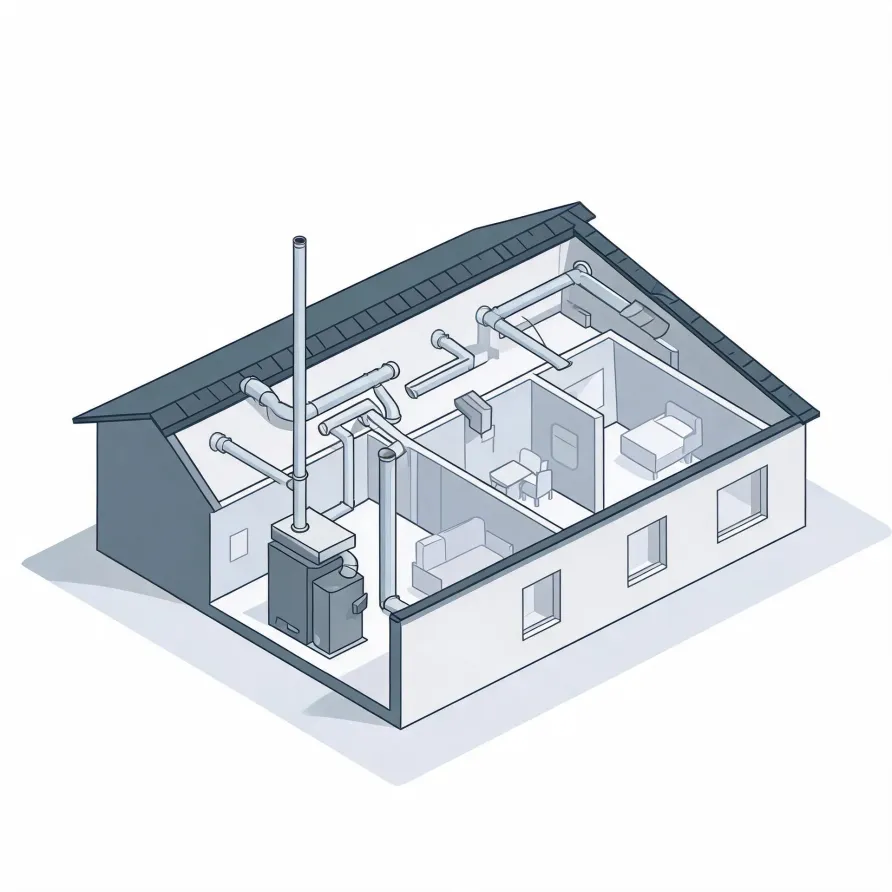
The furnace itself sits inside the home, most often in a basement, utility room, or closet. It is the central unit that heats the air and pushes it out to the rest of the house. A flue pipe runs from the furnace to an exterior wall or roof, carrying combustion gases out.
The thermostat mounts on an interior wall where the homeowner controls the system. A new furnace also comes with a filter housing built into or adjacent to the unit, and the supply and return air connections where the ductwork meets the equipment.
The drawing shows a typical layout, and a licensed contractor determines what the installation involves in your specific home.
Find a contractor in Hughes CountyHughes County, by the numbers
224 severe weather events were recorded in Hughes County, South Dakota between 2015 and 2024.
NOAA National Centers for Environmental Information, Storm Events Database, bulk CSV export, events 2015-01-01 through 2024-12-31.Half the homes in Hughes County, South Dakota were built in 1978 or earlier (2020-2024 ACS 5-year).
U.S. Census Bureau, 2020-2024 American Community Survey 5-Year EstimatesHughes County, South Dakota holds 7,997 housing units (2020-2024 ACS 5-year).
U.S. Census Bureau, 2020-2024 American Community Survey 5-Year EstimatesOwners occupy 72.0% of the occupied homes in Hughes County, South Dakota (2020-2024 ACS 5-year).
U.S. Census Bureau, 2020-2024 American Community Survey 5-Year EstimatesCodes & Standards Governing Furnace Installation in Hughes County, South Dakota4 sourced rules and standards
What happens during HVAC installation in Hughes County
Non-weatherized gas furnaces manufactured on or after November 19, 2015 must reach 80.0 percent AFUE.
Non-weatherized oil-fired furnaces manufactured on or after November 19, 2015 must reach 83.0 percent AFUE.
Mobile home gas furnaces manufactured on or after November 19, 2015 must reach 80.0 percent AFUE.
Non-weatherized gas furnaces manufactured on or after December 18, 2028 must reach 95.0 percent AFUE, up from the 80.0 percent minimum that applies to units manufactured before that date.
Severe Weather Events in Hughes County
Extreme weather puts real demands on heating equipment, from how hard a furnace has to work to how long components last under repeated stress. A furnace sized and installed for local conditions handles those demands differently than one spec'd for a milder climate.
224 severe weather events, 2015–2024. Source: NOAA National Centers for Environmental Information, Storm Events Database.